Category: Planets

  • Venus in Libra

    Venus in Libra

    When Venus, the goddess of love, enters the harmonious and balanced sign of Libra, she finds one of her most welcoming homes, as Libra is one of the signs she rules. In this cardinal air environment, Venus’s expressions of love, beauty, and attraction are bathed in sociability, grace, and a strong desire for harmony and fairness. Venus in Libra seeks relationships that reflect her ideal of balance and beauty, valuing cooperation, mutual understanding, and aesthetics in all forms.

    Love: The Quest for Perfect Balance

    Under Libra’s influence, love is a quest for balance, harmony, and justice. Venus in Libra is drawn to partners who can be both lovers and best friends, where open communication and mutual respect form the foundation of the relationship. This Venus loves with innate elegance and grace, always seeking to ensure both sides feel heard and valued. Here, love is about giving as much as receiving, a delicate back-and-forth dance that keeps the relationship in a constant state of equilibrium.

    Beauty: Harmony in All Things

    For Venus in Libra, beauty is found in harmony and balance. This placement delights in refined aesthetics, symmetry, and perfect proportions. There’s an appreciation for art, fashion, and any form of expression that manages to capture the essence of classical beauty. Venus in Libra is drawn to what is visually pleasing, to environments that exude peace, and to people who carry themselves with natural grace.

    Attraction: Ignited by Diplomacy and Charm

    Attraction, when Venus resides in Libra, is ignited by diplomacy, charm, and the ability to navigate social relationships with ease. This sign is attracted to those who show a genuine interest in others, who can maintain a stimulating conversation, and who possess courteous and considerate behavior. The initial spark for Venus in Libra often comes from admiration for someone’s ability to create harmony and beauty in their surroundings.

    Relationships: Built on Mutual Understanding

    In relationships, Venus in Libra seeks to build on mutual understanding and cooperation. This Venus values equitable partnerships, where compromise and negotiation are seen as essential tools for maintaining peace and harmony. Relationships are viewed as collaborative art projects, where both individuals actively contribute to creating a union that is both aesthetically and emotionally satisfying. Venus in Libra prefers a relationship that is both a reflection of her ideal of beauty and a bastion of fairness and justice.

    Passion: Fueled by Aesthetic and Emotional Connection

    Passion for Venus in Libra is fueled by aesthetic and emotional connection. This Venus experiences passion through shared appreciation of beauty, whether in art, music, or fashion, and through the depth of emotional connection achieved when true mutual understanding is reached. The passion in these relationships is sophisticated and measured, with an emphasis on creating moments that are both visually appealing and emotionally enriching.

    Venus in Libra teaches us that love can be a living work of art, an expression of beauty and balance in action. It reminds us of the importance of harmony in our relationships, of finding beauty in connection and mutual understanding, and of the allure of a love that is both fair and aesthetically pleasing. In Libra, Venus celebrates the power of love to unite and beautify, showing us that true harmony is found in the perfect balance between giving and receiving.

  • Venus in Virgo

    Venus in Virgo

    When Venus enters the meticulous and practical sign of Virgo, the goddess of love embodies qualities of precision, service, and modesty. In this mutable earth sign, Venus’s expressions of love, beauty, and attraction are imbued with thoughtfulness, attention to detail, and a desire for improvement and usefulness. Venus in Virgo seeks meaningful, refined relationships and values sincerity, helpfulness, and simplicity in love and beauty.

    Love: An Act of Service

    Under Virgo’s influence, love is often expressed as an act of service. Venus in Virgo is drawn to partners who appreciate the small, thoughtful gestures that demonstrate care and attention. This Venus loves by doing—whether it’s helping with a task, offering support during challenging times, or simply being there in the most practical ways. Here, love is about showing up and being useful, about caring for the wellbeing of the beloved in tangible, everyday ways.

    Beauty: The Elegance of Simplicity

    For Venus in Virgo, beauty is found in the elegance of simplicity and the perfection of the small details. This placement finds beauty in cleanliness, organization, and the minimalistic. There’s an appreciation for the craftsmanship of well-made items, the purity of natural materials, and the tranquility of spaces that are both functional and aesthetically pleasing. Venus in Virgo is attracted to understated elegance, to beauty that doesn’t need to shout to be acknowledged.

    Attraction: Sparked by Intellect and Competence

    Attraction, when Venus resides in Virgo, is sparked by intellect, competence, and the ability to solve problems. This sign is drawn to those who are articulate, intelligent, and efficient in their actions. The initial spark for Venus in Virgo often comes from a shared interest in improvement—whether personal, in a project, or in the world. The allure lies in the meeting of minds that can work together toward a common goal with precision and dedication.

    Relationships: Built on Mutual Growth and Support

    In relationships, Venus in Virgo seeks to build on mutual growth and support. This Venus values partnerships where both individuals are committed to bettering themselves and each other, where there is a shared dedication to health, work, and daily routines. Relationships are seen as partnerships of equals, where both parties contribute their skills and strengths to create a harmonious and efficient life together. Venus in Virgo prefers a relationship grounded in reality, with an emphasis on practical support and shared values.

    Passion: Fueled by Devotion and Perfection

    Passion for Venus in Virgo is fueled by devotion and the pursuit of perfection. This Venus experiences passion through the dedication to a shared cause or project, through the mutual striving for excellence, and through the deep satisfaction that comes from knowing one is truly useful and valued by their partner. The passion in these relationships is often quiet and reserved, with an emphasis on the deep, underlying bond that grows from working and being together in the minutiae of daily life.

    Venus in Virgo teaches us that love can be an offering of service, a commitment to improvement, and an appreciation for the modest and the refined. It reminds us of the importance of being present in the practical aspects of our relationships, of finding beauty in simplicity, and of the allure of a love that is grounded, sincere, and devoted to making the everyday extraordinary.

  • Venus in Leo

    Venus in Leo

    When Venus enters the radiant and fiery realm of Leo, the goddess of love adorns herself with the regality and warmth of the Sun. In this fixed fire sign, Venus’s expressions of love, beauty, and attraction are imbued with confidence, generosity, and a flair for the dramatic. Venus in Leo seeks passionate, loyal relationships and values the recognition and appreciation of love and beauty.

    Love: A Grand Affair

    Under Leo’s influence, love becomes a grand affair. Venus in Leo is drawn to romantic gestures, grand expressions of affection, and partners who are willing to put love on a grand stage. This Venus loves with a generous heart, seeking to make the beloved feel special and adored. Here, love is not just a private emotion but a celebration to be shared and displayed, a testament to the joy and warmth it brings.

    Beauty: The Splendor of Creativity

    For Venus in Leo, beauty lies in the splendor of creativity and self-expression. This placement finds beauty in bold colors, dramatic designs, and anything that makes a statement or sparks joy. There’s an appreciation for the arts, for creativity, and for individuals who are unafraid to stand out and express their unique selves. Venus in Leo is attracted to the radiant, the spectacular, and finds beauty in confidence and the courage to be one’s true self.

    Attraction: Magnetized by Charisma

    Attraction, when Venus resides in Leo, is magnetized by charisma and the ability to shine. This sign is drawn to those who exude confidence, who are comfortable in the spotlight, and who can match their passion and intensity. The initial spark for Venus in Leo often comes from a shared sense of adventure, a mutual appreciation for drama and excitement, and the lure of a partnership that feels both exhilarating and secure.

    Relationships: Built on Loyalty and Admiration

    In relationships, Venus in Leo seeks to build on loyalty and admiration. This Venus values partnerships where both parties can feel proud of each other, where mutual respect and esteem are given and received. Relationships are seen as mutual fan clubs, where both individuals are encouraged to shine and where their successes and qualities are celebrated. Venus in Leo prefers a relationship that feels like a royal alliance, with an emphasis on loyalty, warmth, and the mutual admiration of each other’s greatness.

    Passion: Fueled by Affection and Recognition

    Passion for Venus in Leo is fueled by affection and recognition. This Venus experiences passion through grand romantic gestures, creative expressions of love, and the feeling of being seen and celebrated. The passion in these relationships is often bold and vibrant, with an emphasis on making the partner feel cherished and valued, and on creating moments that are both memorable and heartwarming.

    Venus in Leo teaches us that love can be both a bold declaration and a generous act of giving. It reminds us of the importance of self-expression, of celebrating our own and our partner’s uniqueness, and of the joy in creating a love story that is as radiant and warm as the Sun itself. In Leo, Venus celebrates the power of love to inspire greatness, the beauty of generosity, and the allure of a love that is both loyal and grand.

  • Venus in Cancer

    Venus in Cancer

    When Venus enters the nurturing waters of Cancer, the goddess of love embraces the qualities of care, emotional depth, and the desire for emotional security. In this cardinal water sign, Venus’s expressions of love and beauty become infused with sensitivity, intuitiveness, and a strong connection to home and family. Venus in Cancer seeks to create deep, meaningful emotional bonds and values the comfort and safety of close relationships.

    Love: An Emotional Sanctuary

    Under Cancer’s influence, love is an emotional sanctuary. Venus in Cancer is drawn to partners who offer emotional security and comfort, who understand the importance of care and nurturing in a relationship. This Venus loves through acts of kindness, creating a safe haven for loved ones, and sharing emotions openly and honestly. Here, love is about building a deep emotional connection that serves as a foundation for the relationship, where both partners feel protected and cherished.

    Beauty: The Comfort of the Familiar

    For Venus in Cancer, beauty is found in the comfort of the familiar, in the simple pleasures that evoke feelings of nostalgia and warmth. This placement finds beauty in things that have personal meaning and history, whether it’s a family heirloom, a vintage piece, or a homemade meal. There’s an appreciation for the beauty in domestic life and the creation of a cozy, welcoming home environment that reflects one’s inner emotional world.

    Attraction: Drawn to Emotional Depth

    Attraction, when Venus resides in Cancer, is drawn to emotional depth and sensitivity. This sign is attracted to those who show vulnerability, who are in touch with their emotions, and who can express their feelings with sincerity. The initial spark for Venus in Cancer often comes from emotional resonance and the feeling of being understood on a deep, intuitive level.

    Relationships: Creating a Shared Emotional World

    In relationships, Venus in Cancer seeks to create a shared emotional world. This Venus values partnerships where there is mutual care, where emotions are respected, and where both individuals can grow emotionally together. Relationships are seen as nurturing spaces, where both parties contribute to creating a sense of belonging and emotional fulfillment. Venus in Cancer prefers relationships that feel like coming home, with an emphasis on emotional support and understanding.

    Passion: Intimacy and Emotional Connection

    Passion for Venus in Cancer is rooted in intimacy and emotional connection. This Venus experiences passion through deep emotional exchanges, through the sharing of innermost thoughts and feelings, and through the physical expression of love that reinforces the emotional bond. The passion in these relationships is often tender and profound, with an emphasis on the emotional significance of being together and the mutual nurturing of each other’s hearts.

    Venus in Cancer teaches us that love is a nurturing force, a balm for the soul that offers comfort and security. It reminds us of the importance of emotional connections, of creating a safe space for love to flourish, and of the beauty in sharing our inner worlds with those we care about. In Cancer, Venus celebrates the strength found in vulnerability, the beauty of care and compassion, and the allure of a love that nurtures and protects.

  • Venus in Gemini

    Venus in Gemini

    When Venus graces Gemini, the goddess of love adopts the mask of the communicator, the intellectual, and the social butterfly. In this airy and mutable sign, Venus’s expressions of love, beauty, and attraction become infused with curiosity, versatility, and a love for the exchange of ideas. Venus in Gemini thrives on mental stimulation and values the freedom to explore diverse interests and social connections.

    Love: A Dance of Minds

    Under Gemini’s influence, love becomes a dance of minds. Venus in Gemini is drawn to partners who can engage in witty banter, share ideas, and keep up with their ever-changing interests. This Venus loves through conversation, through the sharing of thoughts and the mutual exploration of the world’s vast tapestry. Here, love is not just an emotional or physical connection but an intellectual bond that thrives on variety and communication.

    Beauty: The Allure of Versatility

    For Venus in Gemini, beauty lies in versatility and the ability to adapt. This placement finds beauty in diversity, in the eclectic and the novel. There’s an appreciation for the clever use of words, for the elegance of ideas, and for the individuals who can wear many hats with grace. Venus in Gemini is attracted to the dynamic, the ever-changing, and finds beauty in the ability to see the world from multiple perspectives.

    Attraction: Sparked by Curiosity

    Attraction, when Venus resides in Gemini, is sparked by curiosity and the thrill of the new. This sign is drawn to those who can stimulate their mind, who bring fresh insights and perspectives into their lives. The initial spark for Venus in Gemini often comes from a stimulating conversation or a shared laugh, highlighting the importance of intellectual compatibility and the joy of discovery in their relationships.

    Relationships: Built on Freedom and Flexibility

    In relationships, Venus in Gemini values freedom and flexibility above all. This Venus seeks connections that allow for personal growth and the exploration of individual interests. Relationships are seen as dynamic partnerships, where both parties are encouraged to learn, evolve, and maintain their independence. Venus in Gemini prefers a relationship that feels more like a lively dialogue than a binding contract, with an emphasis on mutual respect for each other’s need for space and variety.

    Passion: Fueled by Intellectual Connection

    Passion for Venus in Gemini is fueled by intellectual connection and the excitement of learning new things together. This Venus is energized by lively discussions, spontaneous adventures, and the sharing of experiences. The passion in these relationships is often light-hearted and playful, with an emphasis on fun and the joy of being together in the moment.

    Venus in Gemini teaches us that love can be a journey of the mind as much as the heart. It reminds us of the importance of communication, intellectual stimulation, and the freedom to explore the world both together and as individuals. In Gemini, Venus celebrates the joy of connection through conversation, the beauty of diversity, and the allure of a love that is always evolving, always curious, and always open to the new.

  • Venus in Taurus

    Venus in Taurus

    When Venus, the goddess of love, enters the calm and sensual realm of Taurus, her essence manifests through stability, pleasure, and a deep appreciation for life’s earthly beauties. Venus naturally rules Taurus, so here, in its domicile, its energy feels comfortable and exalted, blossoming into an expression of love that values constancy, loyalty, and the enjoyment of the senses.

    Love: The Depth of Devotion

    Under the sign of Taurus, love becomes a garden that must be tended with patience and dedication. Venus in Taurus loves slowly but deeply, weaving connections based on trust and stability. There’s no rush in its approach; every step towards intimacy is savored and appreciated. This Venus seeks a love that lasts, a bond that strengthens over time, like wine that improves with age. Devotion here is an art form, and fidelity, its finest brushstroke.

    Beauty: The Enchantment of the Sensory

    For Venus in Taurus, beauty is found in the tangible world: the scent of the earth after rain, the texture of soft fabric, the taste of exquisite food. This Venus delights in sensory pleasures, finding the divine in the most mundane details of everyday life. The appreciation of beauty becomes a meditative act, a way of being present and deeply connected to the physical world.

    Attraction: The Flame of Sensuality

    Attraction in Venus in Taurus is a flame that ignites slowly, fueled by sensuality and physical connection. This sign is drawn to solidity, both in character and in physical presence. Emotional security and comfort are aphrodisiacs for Venus in Taurus, which values those who can create an atmosphere of peace and pleasure. Attraction here is less about adventure and more about finding someone with whom to build a refuge from the outside world.

    Relationships: Building a Home Together

    In relationships, Venus in Taurus yearns to build something lasting. This is a love best expressed through acts of service and the creation of a shared home that is both a sanctuary and a space of pleasure. Venus in Taurus seeks partners who share its value for stability and comfort, and who are willing to invest in the long term. Relationships for this Venus are a ground to plant dreams together, watered with commitment and mutual care.

    Passion: The Power of Presence

    Passion for Venus in Taurus is a bodily experience, intensely rooted in the here and now. It’s an encounter of bodies and souls communicating through touch, taste, smell. This Venus finds the erotic in the simplicity of physical connection, in the ability to be fully present with another being. Passion is lived in stillness as much as in movement, in the ability to simply be, together, in full appreciation of the moment.

    In Taurus, Venus teaches us that the most enduring love is one that grows patiently, that is nourished by simple pleasures, and that finds its truest expression in constancy and presence. It reminds us of the power of the tangible, of the sensory, and invites us to seek beauty in the foundation of our daily lives. In this sign, Venus celebrates love as a gift from the earth, a treasure discovered in the depth of devotion and in the richness of shared senses.

  • Venus in Aries

    Venus in Aries

    Imagine Venus, the goddess of love, beauty, and relational harmony, donning the fiery armor of Aries. In this vibrant and dynamic sign, Venus’s expressions of love and attraction take on the characteristics of boldness, initiative, and a pioneering spirit. The Aries influence brings an immediacy and directness to Venus’s usual grace, urging us to chase after what we desire with unbridled passion and courage.

    Love: A Conquering Force

    When Venus finds herself in Aries, love is an adventure to be pursued with the heart of a warrior. To love under this sign is to be fearless in the face of vulnerability, to view the act of falling in love itself as a thrilling battle where the stakes are nothing less than the heart itself. Venus in Aries loves with a spontaneous intensity, often igniting quickly and burning brightly, a testament to the immediacy and earnestness of their affections.

    Beauty: The Radiance of Passion

    Under the influence of Aries, beauty is appreciated in its most raw, unfiltered form. Venus in Aries finds beauty in the authentic expression of self, in the courage to be unabashedly you. This placement admires strength, boldness, and the willingness to take risks. Beauty, in this context, is not just in the eye of the beholder but in the daring spirit of the one who beholds.

    Attraction: The Spark of Instantaneous Connection

    Attraction for Venus in Aries is often instantaneous, a spark that ignites the moment eyes meet. This Venus does not wait for love to come knocking; it pursues it with the determination of a hunter. Attraction here is straightforward and uncomplicated, driven by the primal urge to connect and conquer. Venus in Aries finds allure in confidence, assertiveness, and the exhilarating rush of the chase.

    Relationships: A Journey of Self-Discovery

    In relationships, Venus in Aries champions independence and self-discovery. This placement thrives in dynamics where both parties maintain their individuality and encourage mutual growth. Venus in Aries approaches relationships with honesty and directness, preferring to address issues head-on rather than let them fester. Each relationship is seen as an opportunity to learn more about oneself, often through the mirror of the other.

    Passion: The Flame That Lights the Way

    Passion, when influenced by Aries, is the flame that lights the path to action. Venus in this sign experiences passion not just as an emotion but as a call to action, a force that compels them to pursue their heart’s desires. This is a passion that is both invigorating and inspiring, pushing both the individual and those they are passionate about towards new heights and experiences.

    Venus in Aries teaches us that love can be both a battlefield and a playground. It reminds us that there is bravery in being the first to say “I love you,” that there is beauty in strength, and that the greatest adventures in life are often those that start with a leap of faith. In this fiery sign, Venus encourages us to chase after love with all the boldness and enthusiasm of a heart untamed.

  • The Planets in the 12th House: Tuning into the Collective

    The Planets in the 12th House: Tuning into the Collective

    Planets in the 12th House – Natal Position

    Planets located in the 12th House can make us sensitive to energies or influences that we are not always able to identify as our own because they originate from the collective unconscious or from the repressed and unresolved experiences of other people. This connection can be disconcerting because we process and feel these energies without having a direct or conscious connection to them.

    Individuals with planets in this area of their natal chart may have access to information and energies floating in the ether of the collective unconscious. Due to the nebulous and hidden nature of the 12th House, these energies can be difficult to discern and manage, and they can influence the person in ways that are not always immediately clear or understandable.

    When these energies are not understood or are mishandled, they can overwhelm or confuse the individual, leading to situations of self-deception, meaningless sacrifice, or a sense of victimization. This is because the 12th House is also associated with unrecognized sacrifices, secret trials, and hidden enemies, which can be both internal and external.

    However, if the individual learns to work with these energies in a conscious and constructive manner, they can ‘bring to light’ information and wisdom from the collective unconscious, acting as a channel or a bridge between the visible and the invisible world. By doing so, they can help others understand and manage their own subconscious and psychic experiences.

    Transiting Planets in the 12th House

    When planets transit through the 12th House in a person’s chart, they bring a temporary focus to the themes of this house, affecting the individual’s subconscious, hidden fears, dreams, and connection to the collective unconscious. These transits can highlight periods of endings, deep introspection, and preparation for new beginnings.

    The influence of transiting planets through the 12th House can prompt individuals to deal with unresolved issues, engage in self-reflection, or experience significant inner changes that might not be visible to the outside world. Just as with natal placements, these transitory periods can be challenging but also offer opportunities for healing, spiritual growth, and greater understanding of oneself and one’s connection to the collective.

    Therefore, at different times in our lives, depending on the movement of planets through our charts, we all connect with these 12th House energies. These periods can serve as important times for personal development, allowing us to tune into deeper aspects of our psyche and the universal human experience, facilitating growth and transformation on a profound level.

    Sun in the 12th House

    Someone with the Sun in the 12th House may feel that their true identity or life’s purpose is hidden or repressed. This position can manifest as a sense of loss of direction or of not belonging, as the individual may be tuning into the ego and lost or unrecognized identities of other people. However, when this individual connects with selfless service activities or spiritual practices, they can find a deep sense of purpose and liberation, illuminating not only their own path but also those around them.

    Moon in the 12th House

    A person with the Moon in the 12th House may unconsciously pick up the emotions and moods of the surroundings, experiencing fluctuations and tides of feelings that do not always belong to them. This can lead to a sense of emotional confusion or being overwhelmed without a clear reason. However, if this person learns to differentiate between their own emotions and those absorbed from the outside, they can find a great capacity for empathy and healing, becoming an emotional refuge for others.

    Mercury in the 12th House

    Someone with Mercury in the 12th House may experience difficulties expressing their thoughts or communicating clearly, as they may pick up and process subliminal thoughts and messages from the collective. This can manifest as verbal slips or frequent misunderstandings. Nevertheless, this position confers a great capacity for intuitive or psychic communication. By cultivating meditation or contemplative practices, the individual can learn to filter and clarify these signals, becoming a powerful channel for intuitive wisdom.

    Venus in the 12th House

    A person with Venus in the 12th House may feel inexplicably drawn to hidden or sacrificial relationships, perhaps reflecting the unrecognized or repressed love of others. This can result in feelings of unfulfilled love or self-worth. However, by confronting and healing these projections, they can discover a deep capacity for unconditional love and compassion, attracting healthier and more balanced relationships.

    Mars in the 12th House

    Someone with Mars in the 12th House may experience a sense of powerlessness or repressed anger, as if they were fighting against invisible enemies. This could be because they are channeling unresolved conflicts or repressed aggressions from the collective. Consciously working with this energy through physical activity or therapy can help release these tensions productively, allowing the individual to stand up for causes greater than the personal self.

    Jupiter in the 12th House

    A person with Jupiter in the 12th House may feel an incessant search for meaning and truth beyond the tangible self, which can lead to experiences of expansion through solitude or suffering. This position can make the person particularly sensitive to collective beliefs and hopes. By channeling this energy towards spiritual or humanitarian growth, they can find a deep sense of connection and purpose, benefiting many.

    Saturn in the 12th House

    Someone with Saturn in the 12th House may experience a deep sense of duty or a karmic burden, feeling that they must face limitations or fears that are not always their own. Through inner work, meditation, and confronting their own fears, they can free themselves from these chains, finding deep wisdom and the ability to set healthy boundaries.

    Uranus in the 12th House

    With Uranus in the 12th House, the individual may experience sudden changes or life-altering revelations that seem to come out of nowhere. This can be a reflection of collective changes and the undercurrents of society. By learning to flow with these sudden changes, they can become an agent of change and an innovator at the deepest level, channeling the currents of transformation for the greater good.

    Neptune in the 12th House

    An individual with Neptune in the 12th House may experience a deep and natural connection with the realm of the intangible and spiritual, but may also find themselves lost in the mist of illusion or deception, especially if that fog originates from the collective unconscious. This positioning can make the person extremely sensitive to environmental and psychic energies, absorbing the pain and suffering of the world like a sponge. However, if they manage to establish clear boundaries and develop their discernment, they can access a deep source of compassion and artistic creativity, and act as a channel for healing and spiritual inspiration.

    Pluto in the 12th House

    Someone with Pluto in the 12th House may unknowingly echo the repressions or unresolved issues of other people. This can manifest as a sense of exhaustion, nervousness, or pressure without an apparent cause, because the individual is tuning into deep and often intense problems that do not directly belong to them. However, when someone close or even someone within the collective confronts and resolves these repressions or issues, the energy is released not only for that person but also for those sensitive to these vibrations, like the individual with Pluto in the 12th House. Therefore, they may suddenly feel relieved or freed without fully understanding why.

    Chiron in the 12th House

    Someone with Chiron in the 12th House may secretly carry the wound of the collective soul, feeling the pain of the world as their own and experiencing feelings of isolation, sacrifice, or victimization that can be difficult to understand or explain. This position suggests karmic challenges or hidden wounds that need to be acknowledged and healed. Through personal work and introspection, this person can find ways to heal not only their own wounds but also those of others, becoming a ‘wounded healer’ who brings light and hope to the darkest places of the human psyche.

    Lilith in the 12th House

    A person with Lilith in the 12th House may experience a profound connection with the dark and rejected side of the collective unconscious. This positioning can make the individual feel drawn to the occult, the taboo, or aspects of life and of themselves that society prefers to hide or ignore. Lilith here represents the qualities and desires that have been suppressed or unrecognized, both personally and collectively. Someone with this configuration may face challenges related to fear, shame, or guilt that emerge without a clear source, reflecting the repressions and rejections of the broader collective. They may often feel misunderstood or marginalized, experiencing situations where their deepest truths or most hidden desires are suppressed or misinterpreted.

    The Power of Planets in the 12th House

    The study of planets in the 12th House reveals a deep and multifaceted dimension of human experience that encompasses both personal challenges and connection with a broader collective level. This house acts as a bridge between the individual self and the collective unconscious, offering unique opportunities for personal growth and transformation.

    A key conclusion on this topic is that while the presence of planets in the 12th House can present significant challenges, such as facing hidden fears, feeling misunderstood, or experiencing periods of solitude or confusion, these same challenges can become powerful avenues for self-discovery and spiritual growth. By consciously working with the energies of the 12th House, individuals can learn to transmute pain and darkness into wisdom and light, finding purpose and meaning in their deepest and most enigmatic experiences.

    Additionally, this area of the natal chart invites reflection on the nature of service and sacrifice. Planets placed here can point towards a calling to help others, especially those who are suffering or in need, reflecting the ability to deeply empathize with others’ pain and struggle. This is not about senseless sacrifice, but an act of compassion and understanding that recognizes our inherent interconnectedness with all beings.

    Finally, the presence of planets in the 12th House can indicate untapped potential for creative and artistic expression. These planets can be a source of profound inspiration, fueling creativity through dreams, visions, and connections with transcendental dimensions of existence. By cultivating and expressing these creative energies, individuals not only find personal healing and release but can also offer healing and hope to others, acting as channels for universal beauty and truth.

    In conclusion, planets in the 12th House teach us about the importance of confronting our shadow, recognizing our connection to the whole, and finding ways to live authentically, transforming our subconscious experiences into sources of strength and clarity. In this sense, the 12th House is not just a house of completion and closure but also of new and profound beginnings, where the end of one cycle marks the birth of another, filled with potential for growth and spiritual enlightenment.
  • The Neptunian Generations

    The Neptunian Generations

    Neptune and its Generational Influence

    Neptune, being a planet associated with spirituality, dreams, creativity, and the dissolution of boundaries, can profoundly influence a generation, shaping its collective perceptions, aspirations, and cultural trends. Here are some ways Neptune can influence a generation in general:

    1. Focus on Spirituality and Collective Consciousness: Neptune encourages a deeper quest for connection, whether with the universe, each other, or within oneself. A generation influenced by Neptune might show a strong interest in spirituality, philosophy, and exploring the subconscious.
    2. Idealism and Sensitivity: Neptune can instill a sense of idealism and heightened sensitivity towards others and the world. This might manifest in social and cultural movements focused on compassion, empathy, and seeking harmonious solutions to global issues.
    3. Creativity and Artistic Expression: Neptune rules art, music, and creativity in general. A generation under Neptune’s influence may be particularly creative, seeking new forms of expression and using art as a means to explore and communicate deeper, universal themes.
    4. Dissolution of Boundaries and Universal Connections: Neptune dissolves boundaries, which can lead to a more unified and holistic understanding of the world. Socially, this might manifest in greater acceptance of diversity and a focus on connectivity and global unity.
    5. Tendency Towards Illusion and Confusion: While Neptune can inspire, it can also confuse. A generation influenced by Neptune might face challenges discerning reality from fantasy, grappling with disillusionments, or dealing with ambiguity in various life areas.
    6. Development of Empathy and Altruism: Neptune’s influence can foster a strong sense of empathy and a desire to help and heal. People may feel more motivated to engage in service activities and seek careers that allow them to contribute to the well-being of others and the planet.

    Neptune’s influence on a generation can be subtle but profoundly transformative, inviting individuals to explore beyond the material and the conventional, towards a deeper, more connected understanding of life and each other.

    Neptune in the Signs and the Neptunian Generations

    Neptunian generations refer to groups of people born during Neptune’s transit through a particular sign. Each transit lasts about 14 years, so individuals born during this period share similar Neptunian characteristics, influenced by the sign Neptune is in. Here’s how each Neptunian generation might be characterized according to Neptune’s sign:

    Neptune in Aries

    These individuals can be pioneers in the spiritual and creative realms, displaying a proactive and sometimes aggressive attitude toward achieving their ideals and dreams. They are known for their bravery and willingness to initiate new movements or ideas.

    Neptune in Taurus

    This generation values beauty, comfort, and material security, blending a sense of stability with a deep appreciation for the aesthetic. They can be innovators in fields that merge art and the material, like fashion and interior design.

    Neptune in Gemini

    Characterized by their sharp minds and communicative abilities, these individuals can excel as writers, speakers, and thinkers. They have a gift for merging logical thought with intuition and are often drawn to education and the media.

    Neptune in Cancer

    This generation has a strong focus on family, home, and community. They are intuitive and protective, often engaging in careers that allow them to care for and nurture others.

    Neptune in Leo

    Individuals with Neptune in Leo can be exceptionally creative and dramatic, with a strong inclination towards the performing arts. They tend to seek personal expression and can be visionaries in fields like cinema, music, and theater.

    Neptune in Virgo

    This group leans towards precision, service, and attention to detail. They are pragmatic but also deeply intuitive, with a special talent for the sciences, medicine, and any field where they can apply their desire to improve and heal.

    Neptune in Libra

    The Neptune in Libra generation has a strong sense of justice, balance, and harmony. They are diplomatic and have a natural affinity for the arts, as well as an interest in fostering peace and understanding among people.

    Neptune in Scorpio

    Deeply emotional and intense, these individuals explore life’s mysteries. They can be passionate and magnetic, often drawn to fields that address psychology, spirituality, and personal transformation.

    Neptune in Sagittarius

    Those with Neptune in Sagittarius are eternal seekers of truth, adventurous and optimistic. They have a strong interest in philosophy, religion, and law, and seek to expand their own horizons and those of others through exploration and education.

    Neptune in Capricorn

    Practical, ambitious, and disciplined, these individuals can dream of greatness and then diligently work to make those dreams a reality. They are often involved in established structures such as government, corporations, and institutions, seeking to transform them from within.

    Neptune in Aquarius

    Innovators, idealists, and often eccentric, the Neptune in Aquarius generation seeks to break norms and advance towards a better, more inclusive future. They are particularly adept with technology and can be pioneers in scientific and social fields.

    Neptune in Pisces

    Intuitive, compassionate, and artistic, those with Neptune in Pisces are extremely sensitive and often gifted in the arts. They seek unity and spiritual connection, and can be mystics, healers, or artists who seek to alleviate the suffering of the world through their work.

    Each Neptunian generation brings its own visions and challenges to the world, influencing culture, art, spirituality, and society in unique and collective ways.

  • How to “Survive” Pluto in Aquarius

    How to “Survive” Pluto in Aquarius

    Watch the Video

    Interpreting Pluto’s Transits in Everyday Life

    Over the next 20 years, Pluto will transit through Aquarius. We have already felt its energy from March 23 to June 11, 2023. After its retrogradation, Pluto will return to Aquarius on January 20, 2024, and will remain there until September 1, 2024. Subsequently, it will retrograde again until November 19 of the same year, thus beginning its direct transit through Aquarius for the next 20 years.

    Although much has been said about the negative effects of Pluto’s transits, the truth is that Pluto has been transiting the skies forever. It is true that, at times, Pluto’s transits are associated with personal crises, especially when they form aspects with personal planets. However, Pluto simply indicates common processes of life. We can consider Pluto as the one responsible for eliminating the residues that obstruct our personal fulfillment. The painful aspect of Pluto has more to do with our resistance to letting go of what we are accustomed to. Often we begin an internal struggle against the Plutonian process, which seeks to eliminate what is outdated, what has already completed its cycle. Attachment to the known creates that resistance, which can translate into “suffering.”

    When Pluto transits through different houses, it does not act in isolation but triggers and enhances elimination processes that are directly related to its natal position. These transits are key moments that activate impulses of growth and internal evolution that promote personal fulfillment.

    While it is a planet that shows us processes of elimination and rebirth, which often happen in the depths of the subconscious, we can feel Pluto’s processes. They often appear as a “pressure” or “repression”, especially in issues related to its natal position. I have already spoken extensively about natal Pluto in the Astrological Houses – and for more detail, you can watch the videos about Pluto or explore my blog.

    Therefore, from my perspective, to understand and make the most of Pluto’s transit in the most constructive way possible, it is essential to pay attention to the transformation process that has been triggered since the moment of our birth.

    Pluto and the World of the Subconscious

    “In the context of astrology, and specifically in relation to the position of Pluto, the term ‘subconscious’ refers to those parts of our mind that operate below the level of everyday consciousness. These are areas of our psyche that contain thoughts, feelings, desires, and memories that we are not actively considering at a given moment, but which still significantly influence our behavior and our perception of the world.

    When it is mentioned ‘subconscious patterns that interfere with our personal evolution’, it refers to habits, beliefs, and emotional responses that are rooted in the subconscious and may not be immediately evident to our conscious awareness. These patterns often form in response to past experiences and can influence how we react to current situations, how we make decisions, and how we interact with others.

    The position of Pluto in a birth chart is interpreted as an indicator of the areas of life where these subconscious patterns are most likely to be activated, challenged, or need to be transformed. Pluto, being a planet associated with deep transformation and regeneration, symbolizes the process of making the unconscious conscious, of confronting and deconstructing these subconscious patterns to facilitate personal growth and evolution.

    Natal Pluto in the Houses

    As a brief reminder, let’s explore the meaning of Pluto in each of the astrological houses:

    • Pluto in the 1st House: ‘The radical transformation of identity and subconscious self-concept, forging a new way of presenting oneself to the world.’
    • Pluto in the 2nd House: ‘The profound redefinition of subconscious values and resources, causing a significant change in what we value and how we obtain it.’
    • Pluto in the 3rd House: ‘The elimination of subconscious thoughts and communication patterns that control our way of exchanging and processing information.’
    • Pluto in the 4th House: ‘The transformation of subconscious emotional and family roots that define our internal security and sense of home.’
    • Pluto in the 5th House: ‘The regeneration of creative expression and subconscious impulses that influence our capacity for enjoyment, love, and creation.’
    • Pluto in the 6th House: ‘The purification of subconscious routines and health habits that determine our wellbeing and daily efficiency.’
    • Pluto in the 7th House: ‘The metamorphosis of subconscious relationships and associations that shape our interactions and agreements with others.’
    • Pluto in the 8th House: ‘The profound reconstruction of subconscious emotional, financial, and spiritual matters that govern our experiences of crisis and change.’
    • Pluto in the 9th House: ‘The transformation of subconscious beliefs and knowledge that direct our search for meaning, spirituality, and expansion.’
    • Pluto in the 10th House: ‘The revolution of subconscious ambitions and power structures that influence our career and public status.’
    • Pluto in the 11th House: ‘The reform of subconscious ideals and community connections that define our role in groups and long-term aspirations.’
    • Pluto in the 12th House: ‘The liberation from hidden subconscious fears and limitations that affect our psyche and connection with the collective unconscious.’

    As we can see, Pluto’s position indicates the area where we will see, eliminate, transform, and reconstruct subconscious patterns that interfere with our personal evolution.

    With the transits, the equation of internal transformation work can be seen like this:

    The elimination, transformation, mutation and reconstruction of (the themes of the house where Pluto transits) which assists the elimination, transformation, mutation and reconstruction of (the themes of the natal house of Pluto).

    Natal Pluto in the Signs

    The signs through which Pluto transits indicate the ‘style’ of Plutonian energy, both internalized and externalized.

    • Pluto in Aries: Internally, it can generate intense impulsivity and a desire for radical change. Externally, it manifests as a transformative force through action and leadership, challenging and renewing existing structures.
    • Pluto in Taurus: Internally, it can foster a deep transformation in personal values and self-esteem. Externally, it manifests in radical changes related to material resources and financial security.
    • Pluto in Gemini: Internally, it can provoke an obsessive quest for information and a profound change in the way of thinking. Externally, it shows as a transformation in communication and the way of connecting with others.
    • Pluto in Cancer: Internally, it influences deep emotional transformation and a revision of family dynamics. Externally, it can lead to significant changes in the home or family structure.
    • Pluto in Leo: Internally, it can trigger an intense transformation of the ego and identity. Externally, it is expressed as a powerful creative force and in the pursuit of recognition.
    • Pluto in Virgo: Internally, it is characterized by self-criticism and deep analysis, focused on what needs to be improved. Externally, it can manifest as a drive towards purification and improvement, either in the personal environment or at work.
    • Pluto in Libra: Internally, it can generate a deep transformation in the way of relating and in the understanding of justice and equity. Externally, it can lead to radical changes in associations and contracts.
    • Pluto in Scorpio: Internally, it intensifies the exploration of deep emotions, fears, and desires. Externally, it manifests as a powerful force of transformation and regeneration, often through crises or significant changes.
    • Pluto in Sagittarius: Internally, it promotes a transformation in beliefs and life philosophy. Externally, it can manifest in radical changes in education, religion, or long-range explorations.
    • Pluto in Capricorn: Internally, it drives a deep review of ambitions and the approach towards authority and discipline. Externally, it manifests as transformations in power structures, career, and institutions.
    • Pluto in Aquarius: Internally, it encourages a transformation in ideas and collective aspirations. Externally, it is expressed in radical changes and social, technological, and community reforms, challenging established systems and promoting innovations.
    • Pluto in Pisces: Internally, it leads to a profound spiritual and emotional transformation, often confronting the most hidden aspects of the subconscious. Externally, it can manifest in the dissolution of boundaries and transformative compassion, as well as in changes in the areas of health and spiritual well-being.

    What happened the last time Pluto transited Capricorn and Aquarius

    Analyzing Pluto’s transit through Capricorn in the period prior to its move into Aquarius in the 1770s can provide an interesting perspective on how its energy manifested differently in these two signs. Remember that Pluto takes about 14 to 30 years to transit through a sign due to its elliptical orbit.

    Pluto in Capricorn

    • Approximate Period: Late 1750s to early 1770s.
    • Historical Context: This era was marked by several important events that reflected the structural and transformative nature of Capricorn.
    • Internal Manifestations:
      • Internal State Reforms: Many states underwent a transformation in their internal structures, including changes in government, administration, and the strengthening of central power.
      • Economic Development: Significant changes in the economy were observed, with the onset of industrialization in some parts of the world, especially in Great Britain.
    • External Manifestations:
      • Conflicts and Wars: Although Pluto in Capricorn tends to be associated with internal transformations, there were also significant external manifestations. Wars, especially those involving the struggle for territorial control and the consolidation of power, were common. These conflicts can be seen as an externalization of the need for political and territorial restructuring.
      • Changes in Colonial Power: The reorganization of colonial power, especially in America and Asia, reflected Pluto’s transformative nature in terms of power structures and control.

    Comparison with Pluto in Aquarius

    Pluto in Aquarius (1770s): During this transit, Pluto influenced revolutionary movements and radical social changes. The most notable example is the American Revolution (1775-1783) and the beginning of the French Revolution (1789), which reflected the nature of Aquarius in terms of reform, rebellion, and breaking with traditional structures. Pluto’s energy in Aquarius manifested in a more visible and collective transformation, with a focus on freedom, equality, and fraternity.

    Conclusion

    Pluto in Capricorn: Although there were significant changes in political, economic, and territorial structures, many of these changes can be interpreted as more ‘internal’ in the sense that they reflected a restructuring of existing systems and a consolidation of power and control. The transformation was more gradual and structural.

    Pluto in Aquarius: In contrast, Pluto’s energy in Aquarius manifested in more abrupt and revolutionary changes, with an emphasis on freedom and breaking with the past. These changes were more ‘external’, visible, and collective, reflecting the innovative and reformist nature of Aquarius.
    In summary, while Pluto in Capricorn was more oriented towards internal transformation and consolidation of structures and systems, Pluto’s transit through Aquarius marked a period of visible revolution and radical changes in society and politics. These historical patterns suggest a more internal manifestation of Plutonian energy in feminine signs (Capricorn) and a more external manifestation in masculine signs (Aquarius).

    Deep Dive into Pluto’s Transit in Aquarius

    In Aquarius, the way Pluto eliminates the necessary to reduce to the essentials everything that has reached the end of a cycle is manifested through mental differentiation. Here new concepts and ideologies come into play, the different, the innovative. We will encounter situations that take us out of the established and revolutionize the status quo. If we try to ‘contain’ progress with restrictive or limiting rules and seek to maintain the ‘established order’, the Plutonian elimination will feel relentless. However, it’s important to remember that Pluto is not necessarily violent; our

    resistance to change makes it feel that way, as we struggle to avoid a natural process. Pluto symbolizes the butterfly emerging from its chrysalis. If we try to reinforce the chrysalis because we feel safe there, our own wings will push to break it and thus unfold freely. Resistance to this natural process can damage our wings or cause the chrysalis to explode violently into a thousand pieces.

    As I have mentioned before, Pluto indicates a process of elimination that reduces to the essentials everything that has reached the end of a cycle. In Aquarius, this elimination occurs through the contrast with what is outdated and no longer allows progress. With this in mind, here I detail a bit more about how Pluto in Aquarius operates in this process of elimination:

    • Plutonian Elimination Process: Pluto is known for its ability to reveal what is hidden and force deep changes. This elimination is not merely destructive; it is a necessary process to get rid of structures, attitudes, or systems that no longer serve an evolutionary purpose. Pluto dismantles to create space for something new and more relevant.
    • Contrast with the Obsolete in Aquarius: In Aquarius, a sign associated with progress, innovation, and forward-thinking, Pluto identifies and eliminates what is outdated and no longer allows progress. This can manifest in a variety of ways, including the reevaluation of ideologies, the breaking of outdated social norms, and the transformation of systems that have ceased to be effective.
    • Promotion of Progress and Innovation: Through this process of elimination, Pluto in Aquarius facilitates the emergence of new ideas, technologies, and social structures that are more aligned with current and future needs. This may involve a significant change in how people relate to each other, how they approach social issues, and how they use technology to advance.
    • Transformation towards the Authentic and Evolved: The outcome of this elimination and transformation is a move towards more authentic and evolved forms of existence, both at the personal and collective levels. Pluto in Aquarius urges individuals and societies to align more closely with values and systems that are genuinely progressive and beneficial for the collective.

    Tips for ‘Surviving’ Pluto in Aquarius

    Each individual or society will experience this process according to their current state. The transit of Pluto in Aquarius will be lived in very diverse ways, as has already happened in the past. During a period when Pluto transits through Aquarius, and considering its transformative influence, here are some tips for navigating this time of change:

    • Keep an Open Mind: Aquarius values innovation and original thinking. Open your mind to new ideas and perspectives, especially those that challenge the status quo or conventional norms.
    • Accept Change: Pluto implies transformation and renewal. Accepting that change is an inevitable part of life can help you adapt more easily to the transitions that occur.
    • Evaluate and Adjust Your Ideals: Reflect on your ideals and beliefs. Pluto in Aquarius is a time to question whether your current values still resonate with you and contribute to personal and collective progress.
    • Promote Collaboration and Community Connection: Aquarius focuses on the collective and community. Look for ways to collaborate and connect with others to drive positive changes and progressive actions.
    • Explore New Technologies and Approaches: Since Aquarius is associated with technology and innovation, this can be a good time to explore new technological tools or innovative methods that can facilitate your life or work.
    • Prepare for Profound Transformation: Recognize that Pluto can bring deep changes that may be challenging but necessary for your growth. Prepare emotionally and mentally to face these changes.
    • Practice Flexibility and Adaptability: Aquarius energy is not very friendly to adaptability. It will help maintaining a flexible attitude and be open to adjusting your plans as needed.
    • Contribute to the Greater Good: Think about how your actions and decisions can benefit not only yourself but also society in general. Pluto in Aquarius encourages a focus on collective well-being.
    • Self-Observation and Personal Growth: Use this period for deep self-observation and consider areas of your life that need transformation or improvement.
    • Beware of Resistance to Change: Avoid resisting the changes that come your way. Sometimes, resistance can make the transformation process more difficult.

    By adopting these approaches, you can better harness the transformative power of Pluto in Aquarius, allowing you to grow and evolve both on a personal level and in your contribution to the wider world.

    Interpreting Pluto’s Transit in Aquarius on a Personal Level

    Considering the transit of Pluto in Aquarius, where the elimination of obsolete structures can arise unexpectedly or through new conceptual understandings, it is crucial to look at the natal position of Pluto in our own birth chart to understand its influence on a personal level. For example, if natal Pluto is in the 2nd House, the current transit of Pluto through the 7th House suggests a ‘metamorphosis of the subconscious relationships and associations that influence our interactions and agreements with others’, reflecting the evolution of our personal values.

    For a more complete interpretation, it is helpful to refer back to the descriptions of Pluto in the various signs and houses mentioned earlier, or even download the summary table for future reference. Make relevant combinations according to your natal chart to better understand how Pluto’s energy is transforming your life. Examine how this energy has manifested in previous transits to familiarize yourself with its influence on your personal experience. This approach will help you understand and navigate the transformation process that Pluto brings – from your own perspective.

    Download the FREE Guide of Pluto in the Houses and Signs

    Guide to Pluto Houses and Signs for Pluto Transit in Aquarius

  • The Meaning of Each Planet in Astrology

    The Meaning of Each Planet in Astrology

    More to read: Planets Keywords

    What do the planets mean in astrology?

    In Western (or Tropical) Astrology, we consider the 11 celestial bodies found in the solar system to be planets – this includes the Moon, Pluto, and Chiron. This comes from ancient times: the ancient Greek astronomers, when observing the sky, realized that certain celestial objects did not remain fixed like others. They called these objects asteres planetai (wandering stars).

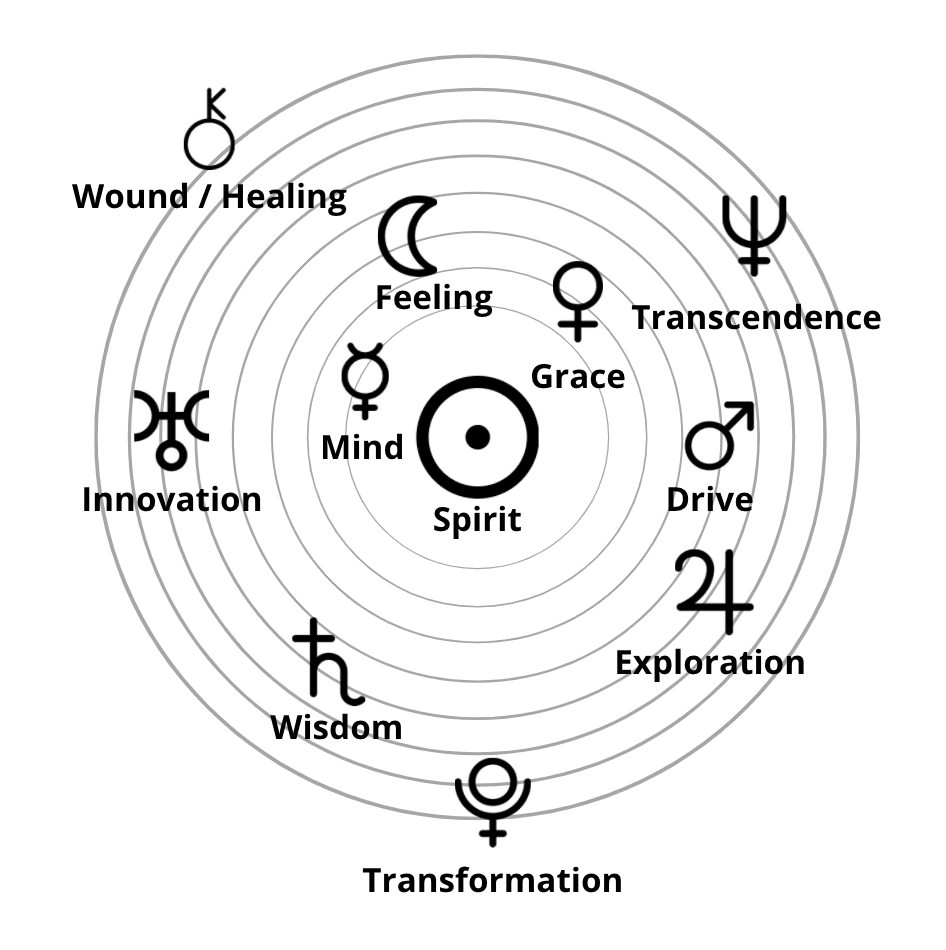
    In astrology, the planets correspond to different aspects of the Self in the same way as the head, the torso, the hands, etc., correspond to different parts of the physical body. The way the planets are expressed depends on their sign. The area of life where they are activated depends on the astrological house where we find them.

    The planets correspond to different aspects of the Self.

    In the birth chart, we can see how the planets (or aspects of the Self) are related to each other. Some do it harmoniously while others may be in conflict. We see this through the aspects (or angles) that the planets form with each other.

    More about this: The Planets as Doors to the Unconscious

    SUN

    RULES LEO

    REPRESENTS THE SPIRIT

    The Sun in astrology is a powerful and multifaceted symbol that encompasses essential aspects of personality, vitality, and life purpose, offering guidance for personal growth and fulfillment.

    These are some key aspects of the Sun:

    1. Source of Life and Vitality: The Sun is the primary source of energy and vitality. Its position in the natal chart indicates where an individual’s life force comes from, how their essential energy is expressed, and how they are nourished internally.
    2. Identity and Central Self: The Sun symbolizes the core of being, the authentic self. Its sign, house, and aspects describe the essence of personality, the sense of ‘self,’ and how that identity is expressed in the world.
    3. Purpose and Direction: The Sun in astrology also represents life purpose and direction. The way the Sun manifests in the chart can give clues about a person’s life mission and how they can realize and shine on their path.
    4. Creativity and Self-Expression: The Sun is associated with creativity and self-expression. The way a person expresses their creativity, finds joy, and personally realizes themselves, is influenced by the position of the Sun.
    5. Consciousness and Self-Knowledge: The Sun symbolizes consciousness and the growth of self-knowledge. Through the solar journey, one seeks internal enlightenment, self-awareness, and the integration of the different parts of being.
    6. Leadership and Personal Power: It also represents leadership and personal power. The way a person asserts themselves, makes decisions, and exercises their will, is influenced by the characteristics of their natal Sun.
    7. Relationship with the Father Figure: In symbolic terms, the Sun can also represent the father figure or paternal authority. It can indicate the nature of the relationship with the father and how this influence has shaped the personality.
    8. Development Throughout Life: The transit of the Sun through the houses and signs of the zodiac throughout a person’s life reflects different stages of growth, challenges, and opportunities for personal and spiritual development.
    9. Relationship with Physical Health and Vitality: Astrologically, the Sun is also associated with physical vitality and overall health. Its strength or weakness in the natal chart can indicate aspects of health and physical energy.

    MOON

    RULES CANCER

    REPRESENTS EMOTIONAL LANGUAGE

    The Moon in astrology is a symbol of emotional life, intuition, memory, and the needs for care and security. It offers a window into our inner world, revealing how we process our emotions and how they influence our perception of the world and our interactions with others.

    These are some key aspects of the Moon:

    1. Emotions and Internal Feelings: The Moon represents the emotional world and a person’s internal feelings. It shows how we process our emotions and our way of instinctively reacting to situations.
    2. Emotional Needs and Security: It is closely linked to our basic emotional needs and to what makes us feel safe and cared for. Its position can indicate what we need to feel emotionally satisfied.
    3. Unconscious and Memory: The Moon symbolizes the unconscious and memory, including childhood memories and ingrained emotional patterns. It can reveal a lot about our habits and automatic responses.
    4. Relationship with the Maternal Figure: Astrologically, the Moon is also associated with the mother or maternal figure. It can indicate the nature of the relationship with the mother and how this influence has affected the emotional personality.
    5. Home and Family: Represents home, roots, and family environment. The Moon in the natal chart can provide clues about a person’s experience in their home and family, and how this has influenced their adult life.
    6. Intuition and Subconscious Perception: It is associated with intuition and subconscious perception. Its position can indicate how a person perceives the world on an intuitive level and how they process that information.
    7. Care and Nourishment: The Moon in astrology is also related to care and nourishment, not only in terms of how we care for others, but also how we care for ourselves.
    8. Emotional Cycles and Life Phases: The Moon, with its changing phases, symbolizes the emotional cycles and life phases of a person. Its transit through the houses and signs can reflect changes in emotional state and emotional needs.
    9. Receptivity and Response to the Environment: The Moon represents receptivity and how we respond to our environment. This can include the way we interact with others and how environments affect us.
    10. Creativity and Personal Expression: Although often seen as passive, the Moon also has a strong connection with creativity and personal expression, especially that which comes from deep emotions and inner experiences.

    MERCURY

    RULES GEMINI AND VIRGO

    REPRESENTS THE MIND

    Mercury in astrology symbolizes the way we think, communicate, and process information. Its position in the natal chart offers insights into our communication style, our learning and reasoning ability, and how we interact with the world around us.

    These are some key aspects of Mercury:

    • Communication and Expression: Mercury rules communication and the way we express our thoughts and ideas. Its position in the natal chart indicates how we communicate, both verbally and in writing, and our ability to transmit and receive information.
    • Mental Processing and Thinking: It is associated with mental processes and the way we think. Mercury influences our logic, rationality, and reasoning skills, as well as our curiosity and openness to new ideas.
    • Learning and Curiosity: Mercury governs learning, education, and curiosity. Its position can reveal how we learn best, what we are interested in learning, and how we approach education and knowledge acquisition.
    • Mobility and Short Trips: In addition to communication, Mercury also rules short trips and daily mobility. This can include how we move in our immediate environment, as well as short and frequent trips.
    • Connections and Social Networks: Mercury influences our social connections and our ability to interact and network with others. It can indicate the ease with which we form connections and manage our social networks.
    • Analysis and Details: It governs analysis and attention to detail. Its position can show how we approach problem-solving and how we handle detailed information.
    • Adaptability and Versatility: Mercury is known for its adaptability and versatility. Its influence can indicate a person’s ability to adapt to different situations and to change ideas or approaches as necessary.
    • Commerce and Business: It is associated with commerce and business, especially those involving information exchange or negotiation.
    • Youth and Play: It is often associated with youth, cunning, and play. Mercury can indicate a playful or ingenious approach to life.
    • Technology and Media: In the modern world, Mercury is also related to technology, especially that used in communication and information processing.

    VENUS

    RULES TAURUS AND LIBRA

    REPRESENTS AFFECTIVE LANGUAGE

    Venus in astrology symbolizes how we experience and express love and beauty, our values and preferences, and our capacity to enjoy life and relate to others. Its position in the natal chart offers a detailed view of our inclinations in these fundamental areas of life.

    These are some key aspects of Venus:

    1. Love and Relationships: Venus is primarily known for its influence on love and relationships. Its position in the natal chart can indicate how we experience and express love, as well as what we value in relationships.
    2. Beauty and Aesthetics: It rules beauty, art, and aesthetics. Venus influences our aesthetic preferences, our appreciation for art, and our inclination towards artistic creativity.
    3. Pleasure and Enjoyment: It is associated with pleasure, enjoyment, and indulgence. Its position can show how we seek comfort and pleasure, and what things bring us satisfaction.
    4. Values and Finances: In addition to love, Venus also governs values and finances. It can indicate our attitude towards money, possessions, and what we consider valuable or important.
    5. Harmony and Diplomacy: Venus promotes harmony, cooperation, and diplomacy. Its influence extends to how we handle conflict, seek peace, and collaborate with others.
    6. Sociability and Attraction: It rules sociability and attraction. Venus influences our ability to attract and be attracted, as well as our way of interacting socially.
    7. Comfort and Luxury: It is associated with comfort, luxury, and material life. Its position can reveal how and on what we like to spend money, as well as our need for physical comfort.
    8. Taste and Preferences: Venus rules our personal tastes and preferences, extending to all aspects of life, from fashion and food to hobbies and interests.
    9. Interpersonal Relationships: Its influence also extends to interpersonal relationships in general, including the way we cultivate and maintain friendships and social connections.
    10. Self-Esteem and Self-Worth: Finally, Venus plays a role in self-esteem and self-worth. It can indicate how we value ourselves and how we seek recognition and appreciation from others.

    MARS

    RULES ARIES AND SCORPIO

    REPRESENTS IMPULSES

    Mars in astrology represents how we direct our energy and passion, how we face conflicts and challenges, and how we express desires and aggressiveness. Its position in the natal chart offers a detailed view of our tendencies in these fundamental aspects of life.

    These are some key aspects of Mars:

    1. Action and Energy: Mars rules action, energy, and initiative. Its position in a natal chart indicates how and in what areas we tend to direct our energy and effort, and how we take initiative.
    2. Desire and Passion: It is associated with desire and passion. Mars influences our passions and desires, as well as the way we pursue what we want.
    3. Aggression and Conflict: Represents aggression and the ability to face conflicts. Its position can reveal how we handle confrontational situations and our tendency towards aggressiveness.
    4. Courage and Bravery: Mars also symbolizes courage and bravery. It indicates the ability to face challenges and the willingness to take risks.
    5. Competitiveness and Ambition: It is linked to competitiveness and ambition. It can show how and in what areas we are most competitive and what our level of ambition is.
    6. Sexual Drive: In addition to general passion, Mars also rules sexual drive. Its position can indicate how we express our sexuality and our sexual energy.
    7. Impulsivity and Patience: It governs impulsivity and patience (or the lack thereof). Mars can show our tendency to act impulsively and our ability to handle frustration.
    8. Survival Instinct: It is associated with the survival instinct. Mars can indicate how we react in crisis situations or under pressure.
    9. Physical Strength and Sport: It is also related to physical strength and sports activities. It can show our inclination towards physical exercise and activities that require energy and endurance.
    10. Assertiveness and Self-Defense: Finally, Mars symbolizes assertiveness and the ability for self-defense. It indicates how we defend our interests and how we assert ourselves in front of others.

    JUPITER

    RULES SAGITTARIUS AND PISCES

    REPRESENTS EXPANSION

    Jupiter in astrology symbolizes growth, expansion, fortune, and the pursuit of a higher meaning. Its position in the natal chart offers a view of the areas of life where we are likely to experience expansion and success, as well as our general attitude towards life and our inclination towards generosity and optimism.

    These are some key aspects of Jupiter:

    1. Expansion and Growth: Jupiter is the planet of expansion, both material and spiritual. Its position in a natal chart indicates areas of life where we are likely to experience growth and expansion.
    2. Optimism and Hope: It is associated with optimism and hope. Jupiter influences our ability to see the positive side of situations and to maintain an optimistic attitude towards life.
    3. Fortune and Luck: Known as the ‘Great Benefactor,’ Jupiter is often associated with fortune and luck. It can indicate areas of life where we are likely to be successful or where things tend to work in our favor.
    4. Philosophy and Wisdom: It rules philosophy, ethics, and the pursuit of wisdom. Jupiter influences our inclination towards philosophical reflection and our desire to understand the world on a deeper level.
    5. Travel and Exploration: It is linked to long-range travel and exploration, both physically and metaphorically. Its position can show an inclination towards adventure and the exploration of new ideas, cultures, and places.
    6. Higher Education and Advanced Learning: Jupiter also rules higher education and advanced learning. It can indicate an inclination towards academic study or training in specialized areas.
    7. Faith and Spirituality: It is associated with faith, religion, and spirituality. Its position can reveal how we approach these aspects of life and our tendency to seek a higher meaning.
    8. Generosity and Abundance: Jupiter is known for its generosity and its ability to provide abundance. It can indicate a tendency towards generosity and sharing what we have with others.
    9. Legality and Ethics: It governs law, ethics, and legal matters. Its position can show how we handle matters of legality and our inclination towards justice and morality.
    10. Excess and Exaggeration: Although benevolent, Jupiter can also lead to excess. Its position can indicate areas where we tend to exaggerate or go to extremes.

    SATURN

    RULES CAPRICORN AND AQUARIUS

    REPRESENTS STRUCTURE

    Saturn in astrology symbolizes the need for structure, discipline, and maturity. Its position in the natal chart offers a view of the areas where we will face challenges and restrictions, but also where we can achieve significant growth through hard work, patience, and overcoming obstacles. Saturn teaches us the importance of responsibility and perseverance in life.

    These are some key aspects of Saturn:

    1. Discipline and Responsibility: Saturn is known as the planet of discipline and responsibility. Its position in a natal chart indicates areas where we need to develop self-discipline, responsibility, and maturity.
    2. Structure and Order: It is associated with structure, order, and organization. Saturn influences our ability to create and maintain structures in our lives, whether personal, professional, or social.
    3. Challenges and Lessons: Saturn often brings challenges and obstacles, which are seen as important lessons for our personal and spiritual growth. It indicates areas of life where we will face tests and how these tests can strengthen us.
    4. Time and Patience: It governs time and patience. Its position can show our relationship with time, our patience, and our ability to work towards our goals over the long term.
    5. Limitations and Restrictions: It is linked to limitations and restrictions. It can indicate areas where we feel limitations or where we need to establish healthy boundaries.
    6. Hard Work and Ambition: Saturn also rules hard work and ambition. It can show our work ethic and our attitude towards achieving long-term goals.
    7. Realism and Pragmatism: It is associated with realism and pragmatism. Its position can reveal our ability to be realistic and practical in our approach to life.
    8. Authority and Power: It governs authority and power figures, including our relationship with them, whether by challenging them or assuming authority roles ourselves.
    9. Traditions and Social Structures: Saturn relates to traditions, social norms, and established structures. It can indicate our relationship with traditions and social structures and our ability to operate within them.
    10. Karma and Destiny: Often associated with karma and destiny, Saturn can represent our karmic debts and the lessons we need to learn in this life.

    URANUS

    RULES AQUARIUS

    REPRESENTS INNOVATION

    Uranus in astrology symbolizes the drive towards freedom, originality, and change. Its position in the natal chart offers a view of how and in which areas of life we are most likely to experience sudden changes, seek innovation, and express our individuality in a unique way. Uranus challenges the established order, fostering growth through transformation and renewal.

    These are some key aspects of Uranus:

    1. Innovation and Originality: Uranus is the planet of innovation and originality. Its position in a natal chart can indicate a drive towards unique ideas and an unconventional approach in various areas of life.
    2. Change and Revolution: It is associated with sudden and revolutionary changes. Uranus influences our ability to adapt to unexpected changes and our tendency to seek or provoke significant changes.
    3. Freedom and Independence: Uranus symbolizes freedom and independence. Its position can reveal a strong need for personal freedom, a rebellious attitude, and a desire to break away from restrictions and limitations.
    4. Technology and Scientific Advances: It governs technology, scientific advances, and everything futuristic. Its position can indicate an interest in these areas or an ability to utilize advanced technologies.
    5. Rebellion and Anti-conformism: It is linked to rebellion and anti-conformism. It can show a tendency to challenge the status quo and resist following established norms.
    6. Intuition and Sudden Perceptions: Uranus is also related to intuition and sudden perceptions, often referred to as ‘illuminations’ or ‘epiphanies.’ Its position can indicate an ability to receive sudden and revealing insights.
    7. Humanitarianism and Collectivity: It governs humanitarianism and collective ideals. Uranus can show a focus on collective well-being and an interest in social or humanitarian causes.
    8. Individuality and Unique Self-Expression: It is associated with individuality and a unique form of self-expression. Its position can reveal a strong desire to express oneself authentically and uniquely.
    9. Breakups and Abrupt Changes: Uranus can bring breakups and abrupt changes in life. Its influence often manifests in unexpected events that significantly alter the course of our life.
    10. Connection with the Collective Unconscious: It is often associated with a connection to the collective unconscious and the thought currents that define an era.”

    NEPTUNE

    RULES PISCES

    REPRESENTS INTEGRATION

    Neptune in astrology symbolizes the realm of the intangible and the spiritual. Its position in the natal chart offers a view of how we experience spirituality, imagination, and empathy, as well as our tendencies towards illusion, confusion, and detachment from the material. Neptune invites us to explore the worlds of dreams, inspiration, and the transcendental.

    These are some key aspects of Neptune:

    1. Spirituality and Inspiration: Neptune is known for its influence on spirituality, inspiration, and connection with the divine. Its position in a natal chart can indicate how a person experiences and connects with the spiritual.
    2. Imagination and Creativity: It is associated with imagination, creativity, and art, especially forms that transcend the everyday or the realistic. Neptune influences our ability to dream and create.
    3. Illusion and Deception: Neptune also rules illusion and deception. It can indicate areas where we are susceptible to self-deception or being deceived, as well as a tendency to idealize or distort reality.
    4. Empathy and Compassion: It is linked with empathy and compassion. Its position can show a deep sensitivity towards others and an ability to empathize with the experiences of other people.
    5. Intuition and Extrasensory Perceptions: It governs intuition and extrasensory perceptions. Neptune can indicate strong intuition or psychic abilities, as well as a connection with the unconscious.
    6. Confusion and Disorientation: It can bring confusion, lack of clarity, and disorientation. Its influence often manifests in periods of uncertainty or disillusionment.
    7. Sacrifice and Redemption: Neptune is associated with sacrifice and redemption. It can indicate areas of life where we experience sacrifice or where we seek redemption.
    8. Detachment from the Material: This planet encourages a detachment from the material and an orientation towards the transcendental or the non-material.
    9. Mysticism and Occultism: It is related to mysticism, occultism, and the mysterious. Neptune can reveal an attraction to these areas.
    10. Escapism and Addictions: Finally, Neptune can also represent escapist tendencies or addictions, as a means to evade reality.

    PLUTO

    RULES SCORPIO

    REPRESENTS TRANSFORMATION

    Pluto in astrology represents deep transformation, processes of death and rebirth, and the management of power and control. Its position in the natal chart offers a view of the areas of life where we experience these intense processes, often through crises or profound revelations, leading us to deep personal regeneration and evolution.

    These are some key aspects of Pluto:

    1. Transformation and Rebirth: Pluto is known for its influence on deep processes of transformation and rebirth. Its position in a natal chart indicates areas where we will experience profound and often radical changes.
    2. Power and Control: It is associated with power, control, and domination. Pluto can indicate how we handle power and control, both on a personal level and in relation to others.
    3. Death and Renewal: It governs themes related to death and the end of cycles, but also with renewal and the beginning of new cycles. Its position can show areas where we face significant endings and beginnings.
    4. Subconscious and Deep Psychology: It is linked to the subconscious and deep psychology. Pluto can reveal hidden aspects of our psyche and deep internal processes.
    5. Crisis and Overcoming: It can bring intense crises and challenges that are catalysts for personal growth and transformation. Its influence often manifests in experiences that force us to evolve and strengthen.
    6. Taboos and Secrets: It is related to taboos, secrets, and everything that is hidden or repressed. Pluto can indicate areas of life where we face these themes or where hidden truths are revealed.
    7. Regeneration and Healing: Although Pluto can be disruptive, it is also the planet of regeneration and deep-level healing. Its position can show how and where we can experience profound healing and regeneration.
    8. Emotional Intensity: Pluto is associated with emotional intensity. Its influence can intensify emotions and experiences, leading to greater depth and authenticity in emotional expression.
    9. Research and Discovery: It is linked to research and discovery, especially in areas that require deep and detailed exploration.
    10. Renewal and Purification: Finally, Pluto symbolizes processes of renewal and purification, where the old and obsolete is eliminated to make way for the new.

    CHIRON

    Chiron represents where we feel shame, guilt, and fear. A very deep wound within our sense of Self.

    Chiron in astrology symbolizes our deepest wounds and our capacity to heal and learn from them. Its position in the natal chart offers a view of the areas where we face pain and vulnerability, but also where we have great potential for healing, wisdom, and compassion, both for ourselves and for others.

    These are some key aspects of Chiron:

    1. Wounds and Vulnerabilities: Chiron symbolizes the emotional, physical, or spiritual wounds we carry, often from childhood or as a result of traumatic experiences. Its position in the natal chart indicates areas where we feel vulnerable or wounded.
    2. Healing and Personal Growth: Although Chiron points to our wounds, it also shows our potential for healing. It indicates how we can heal our own wounds and, in the process, help others do the same.
    3. Inner Teacher and Wisdom: It is associated with the wisdom and learning that arise from confronting and working with our wounds. Chiron can reveal our ‘inner teacher’ and the wisdom we gain through our difficult experiences.
    4. Emotional and Spiritual Alchemy: Chiron facilitates the transformation of our painful experiences into understanding, compassion, and wisdom, a process often described as emotional and spiritual alchemy.
    5. Empathy and Compassion: Due to our own wounds, Chiron can increase our empathy and compassion for others, especially those who are suffering or in pain.
    6. Healers and Therapists: Often, people with a prominent Chiron in their natal chart are drawn to helping or healing roles, such as therapists, counselors, doctors, or health workers.
    7. Search for Solutions and Cures: Chiron urges us to seek solutions and cures, not just for our own wounds but also to help others.
    8. Integration of the Physical and Spiritual: It represents the union of the physical and spiritual, showing how our physical and material experiences can lead to spiritual and emotional growth.
    9. Resilience and Strength: Through confronting our wounds, Chiron teaches us resilience and strength, showing us that our most painful experiences can be our greatest sources of strength and wisdom.
    10. Karmic and Transgenerational Wounds: It can also represent karmic or transgenerational wounds, showing patterns or traumas that may have been passed through generations.
  • The Ruler of the 12th House in the 1st House

    The Ruler of the 12th House in the 1st House

    Combining Planets, Rulers and Astrological Houses

    The rulerships of the planets and their positions in the natal chart is a fascinating topic that allows us to understand the complexity of the Self and at the same time the simplicity of the astrological language to describe the multidimensionality of each individual.

    The presence of the ruler of the 12th House in the 1st House suggests that the energy of the planet, inherently connected with the themes of the 12th House, manifests in the individual’s life in a very personal and visible way, but with a strong connection to the collective.

    1. Natural ’12th House’ Energy: The ruler of the 12th House carries with it the qualities of this house, such as the unconscious, the hidden, the spiritual, and the collective. These themes are not always conscious or directly controllable by the individual. Instead, they may manifest as underlying tendencies, impulses, or intuitions that are perceived as coming from outside the conscious self.
    2. Manifestation in the 1st House: Being in the 1st House, this energy is expressed through the individual’s identity, behavior, and appearance. It may seem that the individual ‘receives’ these influences from the 12th House and incorporates them into their way of being and acting in the world.
    3. Connection with the Collective: The presence of the ruler of the 12th House in the 1st House may indicate that the individual has a natural connection or an open channel to collective or universal energies. They may feel driven by forces that seem larger than themselves, or they may identify with themes that transcend their personal experience.
    4. Function as a Bridge or Channel: This configuration can position the individual as a bridge or channel between the personal and the collective. They could have the ability to bring universal or unconscious themes into consciousness and express them in a personal way. This can manifest in various forms, such as empathy towards collective experiences, an intuitive understanding of unconscious patterns, or an interest in working with issues that affect society in general.

    And so, this is how the ruler of the 12th House in the 1st House represents an intersection between the personal and the transpersonal, where the individual is influenced and, in turn, expresses themes that are part of the collective unconscious or universal experience. These influences can become an integral part of their identity and the way they present themselves in the world.

    The Expression of Each Planet as Ruler of the 12th House in the 1st House

    The expression of the energy of the ruler of the 12th House in the 1st House, considering the planet as a channel of expression of the sign where it is located and its relation to the 12th house, varies according to the specific planet.

    1. Sun (Ruler of Leo): The Sun, as a symbol of the self and identity, would reflect collective themes related to self-expression and creativity. The person could be seen as a natural leader or role model, reflecting the collective need for self-affirmation and authenticity.
    2. Moon (Ruler of Cancer): The Moon in this position would suggest a deep emotional and intuitive connection with the collective. The person could be extremely sensitive to the emotional currents of their surroundings, acting as a mirror of the collective’s emotional needs and care.
    3. Mercury (Ruler of Gemini and Virgo): Mercury here would indicate a mind and a way of communicating that reflects and articulates the thoughts and concerns of the collective. They might have a special talent for expressing ideas and concepts that resonate with a broader collective consciousness.
    4. Venus (Ruler of Taurus and Libra): Venus in this position could manifest as a personal expression that embodies and harmonizes the aesthetic or relational values of the collective. The person could be a catalyst for balance and harmony in relationships and in the realm of beauty.
    5. Mars (Ruler of Aries): Mars, as ruler of the 12th House in the 1st House, could represent a manifestation of the collective will and desire for action and affirmation. They might be seen as a pioneer or warrior on behalf of collective or social causes.
    6. Jupiter (Ruler of Sagittarius): Jupiter in this configuration suggests an expansion and a search for meaning that resonates with the collective. The person could be a teacher or guide, expanding others’ horizons through their own quest for wisdom and truth.
    7. Saturn (Ruler of Capricorn): Saturn, as ruler of the 12th House in the 1st House, would indicate a sense of responsibility and structure that reflects the collective needs and limitations. The person could be seen as an example of integrity, discipline, and maturity.
    8. Uranus (Ruler of Aquarius): Uranus would reflect an impulse towards freedom and originality that is part of a broader collective consciousness. The person would be an agent of change and innovation.
    9. Neptune (Ruler of Pisces): Neptune suggests a deep connection with collective spirituality and creativity. The person could be a channel for the collective’s imagination, compassion, and spiritual connection.
    10. Pluto (Ruler of Scorpio): Pluto in this position signals an intense collective need for transformation and renewal. The person could be an agent of profound change, confronting and transforming dark or taboo subjects on behalf of the collective.

    In each case, the presence of the ruler of the 12th House in the 1st House indicates a personal manifestation of collective themes and needs, with the individual acting as a reflection or channel for these broader energies.

Privacy Preference Center